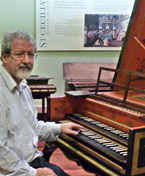
The saga of the Hubbard-Di Veroli harpsichord

by Claudio Di Veroli

Copyright © 2008 by Claudio Di Veroli, Bray Baroque, Bray, Ireland, October 2008


Abstract

This webpage tells the remarkable story of this instrument as it was conceived, built and then played for over three decades.
The Hubbard-Di Veroli harpsichord has been very influential on talented young musicians
that are today well-known professional performers and makers, both in South America and in Europe.
A separate webpage, RESTRINGING A HARPSICHORD WITH TRADITIONAL WIRE, describes
a recent project (2010-11) that further improved this instrument by restringing it.


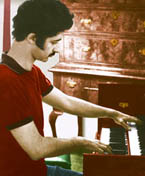
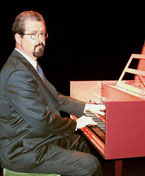
1. BÉDARD AND THE FRENCH HARPSICHORDS. My life as a harpsichord player, tuner and repairman began in my native Buenos Aires in 1962. I was then 16, still fascinated by the "novelty" in Argentina: the modern German harpsichords by Neupert, Sperrhake and Wittmayer. Today's younger players, who rarely if ever encounter the "modern" harpsichord, can watch here beginners trying some of them. In spite of their poor and feeble sound, compared with a modern piano they provided in their time a unique—if limitedwindow into what was required by early keyboard music. The model I played most often was a small Sperrhake, possibly less bad than others: I have found this video in YouTube. In different occasions I had to play it—for a continuo—as late as 1983 as shown in the photo below.


Having started as a teenager with the "modern German" things, later as a student in London in 1968-71 I would become acquainted with ancient harpsichords, which I played very often in the Fenton House, Hampstead, as shown in the pictures below.

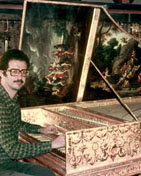
During those years in London, I frequently travelled to Paris, where at the Conservatoire's Musée Instrumental (today Musée de la Musique in La Villette) I met and soon befriended the great harpsichord restorer, maker and player, the late Hubert Bédard. He would generously mentor me in the study of French Baroque music and harpsichords. In countless visits to the Conservatoire, I was given unique permission to practice at length on the 18th-century French double-manual instruments that Bédard and his collaborators had lovingly restored. Playing for hours on end on the Dumont-Taskin, the Collesse (the best looking one), the Goujon (the loudest sounding one) and the golden Ruckers-Taskin (the best sounding one), counts surely as the most amazing musical experience I ever had. See below pictures I took at the time, with permission from the museum, of the Collesse (left) and the Ruckers-Taskin (right).

My main interest has always been the harpsichord music from the High Baroque era c.1650-1750, and it was soon obvious to me that this was the type of instrument I wished to play for the rest of my musical career, meant to be based in my native Argentina. Since I could not even remotely afford a ready-made instrument, in my visits to his atélier, Bédard showed me how a harpsichord is built and instructed me on building a good-quality harpsichord starting from a "basic kit" by Hubbard. In the picture below left, I am with Hubert Bédard in his atélier in Boulogne in 1971. In the picture on the right, I am playing the golden Ruckers-Taskin in the Paris Museum during my visit of 1975.


2. HUBBARD AND HIS HARPSICHORD KITS. Once back in Argentina, in 1972 I ordered a "basic double-French kit" from the late Frank Hubbard, who from Boston (USA) had pioneered the rediscovery of harpsichords based on traditional models. [Hubbard Harpsichords still builds kits and harpsichords under the direction of Hendrik Broekman]. Hubbard wrote in one of his leaflets: "Let me say this about our kits: if the kit is carefully assembled, well voiced and handsomely finished, the result equals the product of any professional maker and resembles its prototype very closely.... ". Indeed, "the Hubbard kit is not easy to assemble—only a skilled and intelligent worker should undertake it; but when successfully assembled, this kit turns out to be a better instrument than the majority of professionally built harpsichords, a point which was made recently ... by Dr. Wolfgang Schroeder in Das Musikinstrument, Jul. 1968" (W. Zuckermann, The Modern Harpsichord, p. 133, 1970). For many years, in spite of a few differences with respect to the original by Pascal Taskin 1769, the Hubbard double kit was a regular winner of international "kit-making competitions".

By the time Hubbard put together the kit in Boston, shipped it, it arrived to Argentina, the customs notified me and I managed—after months of red tape—to receive it, it was November 1973! See below on the left the contents of Hubbard's crate—with my now-deceased father Angelo—except for the loosely-assembled case with belly rails and wrestplank, which are shown on the right.

It is worth noting that a double-manual harpsichord is a wooden case that requires very tight tolerances to withstand more than half a tonne of string tension. Many inferior kits were easier "assemble and glue" affairs, but then they would undergo deformation and/or implosion as soon as the strings were brought up to pitch. Hubbard's kit was instead a collection of materials carefully selected and mostly reduced to the final thickness, but otherwise left oversized, meant to be finished immediately before assembly. It included accurate Mylar plans and a full Instructions manual.

Assembling the kit, like any harpsichord, meant lots of precision work, like sawing and sanding frames until they fitted tightly in place, cutting the soundboard to shape so that it would fit inside the case, planing nuts and bridges to the required shape, making and installing the strings and assembling and fitting the action jacks. To reduce costs, some parts had not been included in the kit and I had them made in Argentina to my own specifications, like the lid, flap, music desk, legs, hitchpins (blackened iron for the 8', golden plated for the 4'), jackrail latch, buff batten and handstops. Hubbard provided two alternative designs for the music desk: the traditional large piece meant to be stored outside the instrument, or a model that fitted inside but required to be moved forwards to allow folding it back before closing the lid. In a letter, Hubbard kindly praised my design, a third alternative that simply folds forwards towards the player, as seen in pictures further below.

3. THE FURNITURE WORKSHOP. Building a harpsichord—even when starting from a basic kit—requires a well-equipped workshop and acquaintance with advanced woodworking practices. Luckily, a family friend owned a small factory where they built customised pieces of furniture. They very generously gave me a large space to work there, and the help of their workers: I only had to pay the direct cost of their wages when working on my harpsichord. During the initial assembly of the case, I would be largely reading from Hubbard's manual and telling the carpenter—in Spanish—what to do. By the time I was gluing ribs and bridges to the soundboard (see photos below), I had acquired the necessary skills to proceed without further help.

In the following years I would repair quite a few kits (none by Hubbard) built by amateurs keen to have their instrument working "as soon as possible": any difficulty was sidestepped, proceeding ahead "to get there no matter what", with final results that covered the whole spectrum from the pathetic to the catastrophic. This was often against my advice to proceed with caution and analysis, as I had done with my kit: I worked on it Fridays and Saturday mornings, and had a day job Monday to Thursday, with plenty of time to mull over any issues. Every single time I found a difficulty, I would stop, analyse and devise a solution, a few times bothering Frank Hubbard with letters that he always responded with kindness and full details, often engaging in very interesting interchanges. It took several months to complete the instrument as a piece of furniture. There was still no painting and no action (see photos below).

4. PAINTING AND STRINGING. At this stage, the instrument was moved to the small apartment where I lived. There a professional painter provided a high-quality modern finish. It was now mid-1974. I then carefully drilled for the 189 hitchpins (compass FF-g''' non-transposing) and more than 400 nut and bridge pins, which I did with a very small hand drill, miraculously managing to get them all parallel (see photo below left). With all the pins in place, the problem was now to determine the stringing schedule.

For this purpose, I wrote FORTRAN programs—probably a pioneer use of computers for harpsichord stringing analysis back in 1974—that calculated for each string the tensions and even printed graphs in the "line printers" of the time, as shown above. There are two types of tension: the STRESS and the PULL. The STRESS is internal to the string material, is measured in kilos per square millimetre of diameter and is a function of string length and pitch. If stress is too low, the sound is not good and a different alloy is needed, while if it is too high, the string may break: either way, stress is paramount for the choice of string alloy. The PULL or LOAD is the force of the string against the case, measured in kilos per string, is a function of the same data and also the string diameter, and is paramount in the selection of the latter because it determines the sound quality: too high a size makes the sound "dull", too low a size makes the string "buzzy". I was not entirely happy with the tensions resulting from the generic stringing schedule (dated 1963) suggested by Hubbard for his kit: a most interesting mail interchange with Frank Hubbard ensued, and eventually he approved both my methods and my final stringing schedule, which differed significantly from his, especially in the 8' choirs. [Decades later I would eventually find that my schedule and the resulting pulls are actually very similar to the ones Taskin inscribed in the wrestplank of most of his harpsichords.] By the end of 1974 the stringing operation was complete.

5. ASSEMBLING THE ACTION AND VOICING. This was the final difficult challenge. I have often seen otherwise excellent instruments failing to perform because of low-quality action. I was determined instead to have the best-sounding instrument one could possibly build from Hubbard's kit. For this—as for any double manual harpsichord—lots of precision work were required. In the harpsichord era, screws were very expensive and scarcely used in harpsichord making, but Hubbard's kit used screws to help attach solidly the 8' hitchpin rail, and also elsewhere, notably in the bottom of the jacks making it easier to regulate their length. These screws, however unhistorical, are convenient for assembly and regulation, and cannot affect either the sound or the action functionality in any possible way.

The German-made keyboards provided by Hubbard at the time were very irregular. The spacings in the back could be off by up to one millimetre: I also found that the black Delrin jacks had a very slight but varying curvature by up to a millimetre, so the solution was to fit the jack deviations to the key deviations. There was also vertical irregularity: once the front of the keys were level, the backs were not, which was compensated for with the jack lengths. The keyboards were—unhistorically—lead balanced, whereby the mass of a lower natural was 80 gr: I removed leads and rebalanced by undercutting the front of the keys, as found in ancient instruments, achieving a mass of only 66 gr. I then painstakingly learned to undercut Delrin plectra to provide the necessary taper: only three broke in more than three decades of use. Finally, the jacks were adjusted for a very careful "staggering": this allowed "voicing" the instrument relatively loud, yet avoiding a heavy action.

Two additions to the stop action provided the additional flexibility needed when playing, with the same instrument, pieces originally meant for very different models. One addition is a "piano stop" lever for the front/upper 8' register (see the shortest stop lever in the middle picture above). In its "forte" position, the loudness is almost imperceptibly softer than the lower 8', while in the "piano" position the difference is clearly audible. Even in the "piano" position though, the upper 8' can be used as a solo stop, and it also adds a significant "punch" when it joins the lower 8' via the coupler. Needless to say, this "piano stop" lever is never used as an expressive device during performance—which would be ridiculous and unhistorical—but only to "customise" the instrument in order to fit different repertoires that seem to imply balance diversities in ancient harpsichord-making traditions. The other addition to the usual disposition consists in the buff batten being provided with two sets of leather pads, acting on either 8' string choir and providing different effects: the buffed upper 8' is quite "pizzicato", while the lower 8' has much smaller pads and sounds remarkably like a guitar. This effect has been mentioned in forums in 2009 and called "singing buff". The matter is justified by the historical variety of buff pads, including buff battens working for either 8' stop in some extant antique harpsichords. I have now setup a separate webpage with guidelines for amateurs about how to fit a "singing buff".

6. PLAYING, RECITALS, REVIEWS. The sound of the instrument, finished in March 1975, was astounding. In April I visited Bédard in Paris and showed him several photos: he said "I cannot tell how it sounds, but this is surely one of the most carefully-built double French I have ever seen." In May the instrument was premiered (not much time to practice!), and luckily some pieces in the recital were recorded. This was the first harpsichord based on traditional models ever heard in Argentina: it caused a strong impression and very soon local harpsichordists started ordering similar instruments from abroad. Six years later, after I played it in Buenos Aires in the National Museum of Decorative Arts in 1981, at a time when there were already other similar instruments in Argentina (some of them built by reputable European makers), in one of the most important newspapers in the country, a reviewer wrote that this was the best-sounding harpsichord in all Latin America. In the 1980's and 1990's the Hubbard-Di Veroli would be employed extensively in public performances, mostly in solo recitals but also with small and large period-instrument ensembles.


The photo above left shows the instrument at the time of its inauguration in 1975. The photo above right was taken in the Bach-Handel-Scarlatti Tercentenary Harpsichord Recital in the large Teatro Coliseo, Buenos Aires, in 1985. This and a few other recitals were recorded, and we have now completed the lengthy process of producing movies and uploading them to YouTube, where they can be found searching for < Di Veroli harpsichord >. To avoid issues with regulation when moving the instrument for recitals, I remove the keyboards and use special screws to block the three registers in an intermediate on/off position. The instrument has always been completely reliable, and concert reviewers and colleagues never cease to praise its sound. Harpsichords are known to be much more diverse than pianos, even when one compares similar instruments by the same (ancient or modern) maker: each instrument has its own distinctive personality, both in sound and in the feeling of the action. The Hubbard-Di Veroli was built for an even and "singing" sound throughout its range, and this is still one of its characteristics: the action also feels very even and reliable.

7. IRELAND . Carefully packed by my son Rafael, the Hubbard-Di Veroli harpsichord survived intact our removal to Ireland in 2001. As before, this instrument never goes out of regulation and very seldom if ever breaks plectra, dampers or strings.

The Hubbard-Di Veroli has been used with success in public recitals here. See above on the left the lovely Bray seafront, and on the right a picture taken not far from there, during a recital in The Mermaid, The Wicklow's Arts Centre in Bray. This harpsichord is held today as one of the finest-sounding instruments in Ireland.


Web site designed and maintained by Seattle PC Service ®, Bray, Ireland                                                                             Page last updated: 06-Sep-2011